By Tim Jarry, CFA, CPA
Principal/Senior Consultant
Uncertainty is not new to institutional investors, but the nature of that uncertainty has changed. Today’s investment programs must navigate more frequent market shifts, wider dispersion in asset class outcomes, greater complexity in private markets, and rising expectations around transparency, mission alignment, and long-term risk management. At the same time, many organizations face internal pressures: leadership turnover, lean staffing, changing liquidity needs, and limited bandwidth for in-depth decision-making.
In this environment, governance is more than a formality. It becomes the structure that allows institutions to act with clarity and purpose, even as external conditions change. Good governance will not guarantee stronger returns, but it creates the conditions for stronger decisions—anchored in policy, aligned with mission, and resilient through transitions.
In this investment perspective, we outline the core elements of effective governance, explore the models institutions use to manage long-term assets, and highlight common pitfalls that can erode oversight. We also draw from our experience to offer practical ideas to help organizations strengthen governance and adapt to evolving needs.
Why Governance Feels Harder
Across the nonprofit landscape, organizations are experiencing pressure on their investment oversight structures due to a few converging factors:
Portfolios are More Complex
Many investment programs now include private equity, venture capital, private credit, hedge funds, and real assets. Each comes with unique liquidity, pacing, and operational requirements, demanding more nuanced oversight than traditional models anticipated.
Decisions Move Faster
In periods of market volatility or operational change, the ability to act decisively matters. Committees and boards designed for slower, quarterly rhythms may find it challenging to respond to emerging risks or opportunities.
Stakeholder Expectations are Rising
Donors, boards, students, regulators, and other constituents are increasingly focused not just on performance, but on how investments support long-term goals and mission.
These challenges are especially visible in higher education, where leadership transitions and budgetary pressures intersect with increasing demands for transparency and mission alignment. But they are by no means limited to one sector, and they highlight the need for governance that is both structured and adaptable.
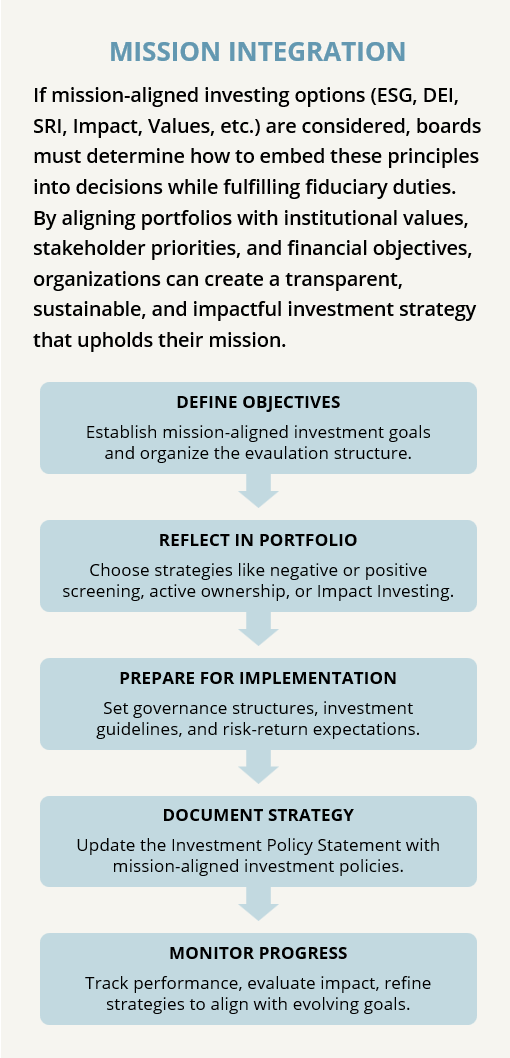 High-Functioning Governance
Effective governance provides a foundation for confident decision-making—even during change. While models vary, we consistently see that strong structures share four core attributes:
Structure, Composition & Leadership
Governance starts with having the right people in the room and a structure that supports effective oversight. High-performing committees are intentionally designed around the institution’s needs and portfolio complexity.
- The committee should be large enough to bring diverse perspectives and small enough to stay efficient and make decisions.
- Committee members should demonstrate a commitment to the institution’s mission and bring relevant expertise that balances necessary skills with diverse perspectives. The chair should be selected intentionally. A strong chair keeps the agenda disciplined, reinforces fiduciary focus, and keeps discussions strategic.
- The committee should include members who add real value by thinking independently, challenging constructively, and supporting continuity—not just reacting to short-term performance.
Clear Roles & Responsibilities
Successful investment oversight begins with clarity around who does what. Governance roles should be well-defined across all levels:
- Boards provide strategic direction and confirm overall risk tolerance.
- Committees guide investment policy, risk posture, and key decisions.
- Staff coordinate internal implementation and communication.
- External partners (i.e., consultants, OCIOs, etc.) support analysis and, when delegated, execute.
Without clarity, committees either overextend or disengage—both of which dilute accountability.
Policy that Drives Real Decisions
The investment policy statement (IPS) should serve as a living document that reflects actual practice. A strong IPS addresses:
- Investment objectives
- Spending or withdrawal priorities
- Liquidity and risk parameters
- Benchmarks and rebalancing rules
- Roles and responsibilities
If the IPS does not reflect the portfolio structure, governance becomes reactive.
Focused, Strategic Use of Meeting Time
High-functioning committees do not aim to cover every detail. They reserve time for policy questions, strategic shifts, and mission alignment, not just performance recaps. Discussions about managers or asset classes are most valuable when linked to the broader goals of the investment program.
Continuity & Education
Strong governance is resilient to turnover. Onboarding, ongoing education, and regular evaluation help institutions maintain oversight quality as committee members or staff change.
Choosing the Right Model
Effective governance is not one-size-fits-all. The key is to match the structure to your institution’s internal capacity, investment complexity, and desired level of control. The most common models include:
- Internal CIO: Investment decisions are managed in-house, offering deep alignment with institutional strategy. However, this model can introduce key-person risk and requires strong controls and succession planning.
- Traditional consulting: Committees retain decision authority over all major actions, with advisors offering analysis and recommendations. This works well when time, expertise, and consistency are present.
- Outsourced CIO (OCIO): Discretion is delegated within defined parameters. The advisor manages implementation, allowing committees to focus on policy and oversight. This model supports faster execution, but demands clear delegation and robust monitoring.
- Hybrid models: Institutions maintain dedicated internal staff who partner with an OCIO that serves as an extension of the internal team. Choosing the right model is ultimately about what will enable your institution to act with discipline and adapt with confidence.
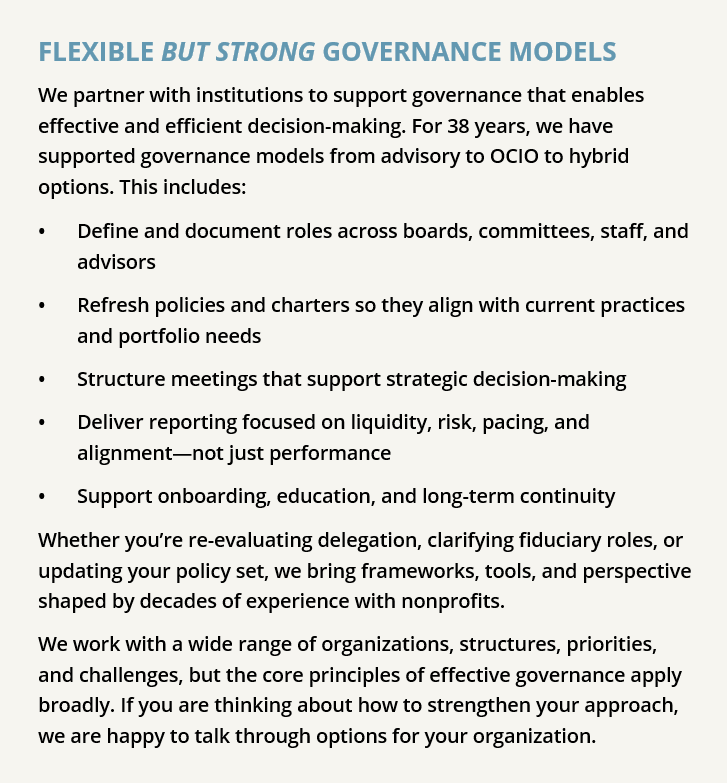
Avoiding Common Pitfalls
Despite best intentions, governance structures often break down in predictable ways:
- Unclear decision authority, leading to delays or duplicated effort.
- Short-term or reactive decision making.
- Policies that don’t reflect the actual portfolio, especially around liquidity or rebalancing.
- Inconsistent meetings, where time is spent catching up rather than making decisions.
- Lack of committee evaluation or onboarding, making governance dependent on memory.
These issues are rarely resolved by adding more meetings. In our experience, small adjustments—like refreshing policy documents, clarifying implementation authority, or strengthening reporting—can meaningfully improve how governance functions and how confident stakeholders feel in the process.
Closing Thoughts
Markets change, leadership turns over, mission priorities evolve, but what remains constant is the structure that governs investment decisions. Good governance helps institutions stay focused, responsive, and resilient through those transitions.
If you are rethinking your governance approach—whether to support growth, manage complexity, or strengthen alignment—we’d welcome the opportunity to share tools and insights to help you move forward.
All commentary contained herein reflects the opinions of Prime Buchholz and is provided for informational and educational purposes only. This material does not constitute investment advice, an offer to sell, or a solicitation of an offer to buy any securities, nor does it invite anyone to make such an offer. The content does not include testimonials, endorsements, or client-specific performance information and is intended solely for institutional audiences, not retail investors. The information is current as of the date indicated and is subject to change without notice. It does not take into account the specific investment objectives, financial situations, or needs of any investor. Any references to governance benefits, operational improvements, or decision-making outcomes are general observations and do not imply that similar results will be achieved by all institutions or under all market conditions. Governance structures and implementation models are discussed for illustrative purposes only; the appropriateness of any approach depends on an institution’s unique circumstances. Nothing herein should be construed as a guarantee of future results. © 2026 Prime Buchholz LLC